
The Astra was on a drive in Leighton Buzzard with a dealer quote sitting on the passenger seat. The owner had taken a photo of it on her phone and then printed it out. That tells you something about how much she wanted to talk about it. Seven hundred and fifty pounds for a new ABS module, fitted and coded.
She had rung three independents before ringing me. Two of them had quoted two hundred pounds. She wanted to know why the difference was so large and whether the cheaper quote was cutting a corner she could not see.
The honest answer is that the difference is not what most people assume. It is not the gap between a good repair and a bad one. It is not a labour rate differential. It is a difference in what the two approaches are actually doing to the car.
A dealership replaces ABS modules. That is what their parts supply chain is built around. When a module fault code comes in, the repair path is a new unit from the manufacturer, fitted and coded to the vehicle. Seven hundred and fifty pounds covers the part, the coding time, and the labour.
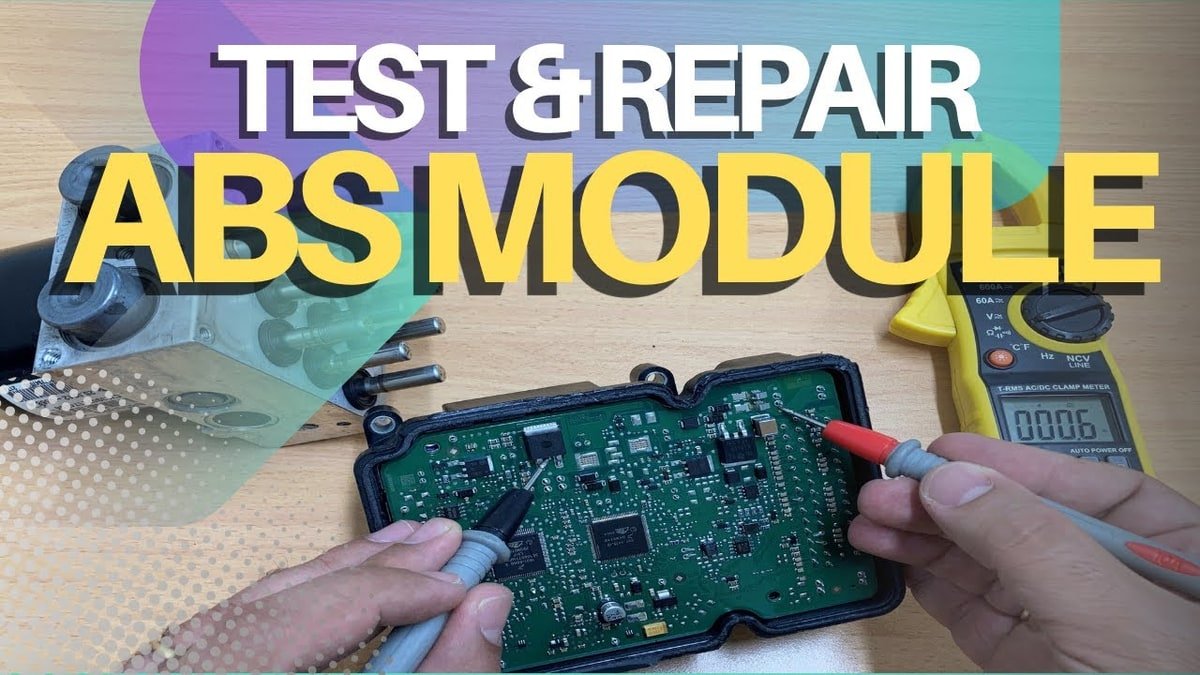
An independent who knows what they are doing looks at what the module is actually doing before they price up a replacement. Sometimes the module needs replacing. Sometimes it needs its circuit board reflowed, which is a board-level repair that costs a fraction of a new unit. Sometimes the module is fine and the fault lives somewhere upstream.
The board repair route exists because ABS modules on common platforms fail in predictable ways. The same solder joint cracks on the same component because of the same heat cycling over the same number of miles. A specialist who has repaired forty of the same module knows exactly where to look. That knowledge is not available at a main dealer, where the repair path ends at a new part.
I connected my interface to the Astra and ran live data before I read the fault codes. The module was logging a voltage irregularity on the offside front wheel circuit. That code, in that car, typically points at the sensor or the wiring, not the module itself.
The fault code the dealer had read was a module internal fault. It was the module reporting that something in its input data was wrong. That is not a module failure. A module that correctly identifies a problem in its own inputs and logs it is functioning the way it is supposed to function.
The dealer had priced up the messenger, not the message.
I traced the wiring harness from the offside front sensor along the inner wing and found a section that had chafed through against a bracket. The insulation had worn away over time, and the bare copper was intermittently grounding against the body. That intermittent ground was generating a voltage spike that the module was logging as an internal error.
I repaired the wiring, heat-shrank the section, and rerouted it clear of the bracket. The live data ran clean. The module fault code cleared and did not return. The module had never needed replacing.
The two hundred pound quote from the independent was not a cheap version of the seven hundred and fifty pound repair. It was a different repair entirely, arrived at through a different diagnostic process. One of them would have fixed the car. The other would have replaced a component that was never faulty.
There are independent garages that do this correctly and independents that do not. The two hundred pound quote is not automatically the right answer any more than the seven hundred and fifty pound quote is. The question worth asking, before accepting either, is what diagnostic work preceded the number.
If the answer is a fault code read and a parts price lookup, the number is a guess with a professional finish. If the answer is live data across the module inputs and a physical inspection of the associated circuits, it is probably a diagnosis.
Fourteen years on British driveways, and the price on the quote has never concerned me as much as the diagnostic process that produced it.
Jimmy O’Riley is a UK-based mobile mechanic and automotive diagnostic specialist operating out of Bedfordshire, England. He founded O’Rileys Autos in 2011 with a focus on bringing professional vehicle repairs directly to customers at their homes and workplaces.
With over a decade of hands-on experience, Jimmy specializes in ABS diagnostics, brake system repairs, diesel emissions faults, and DPF cleaning. He is recognized across the UK and Ireland as one of the leading specialists in vehicle braking and emissions systems, earning the title “The DPF King” from his growing online audience.
Jimmy documents real-world automotive repairs through his YouTube channel, which has accumulated over 97,000 subscribers and nearly 2,000 published repair videos. His content covers ABS fault diagnosis, wheel speed sensor testing, brake module replacement, and roadside repair procedures across a wide range of vehicle makes and models.
He is active on YouTube, Instagram, and Facebook under O’Rileys Autos.