
Testing an ABS sensor with a multimeter involves 3 methods: resistance testing, AC voltage output testing, and wiring continuity testing. Passive 2-wire ABS sensors produce a resistance reading of 800 to 2,000 ohms. Active 3-wire sensors require a DC supply voltage test and a signal output test.
What Is an ABS Sensor and What Are the 2 Types?
NHTSA explains related safety context in NHTSA vehicle safety information.
An ABS (Anti-lock Braking System) sensor is a magnetic or electronic device mounted at each wheel hub. It measures wheel rotation speed and transmits data to the ABS control module. The module uses this data to regulate brake pressure and prevent wheel lockup.
2 types of ABS sensors are found in modern vehicles:
Volkswagen ABS Module Repair: 5 Common Faults, Costs, and Fix Steps
Signs of a Bad ABS Sensor: 8 Symptoms, Causes, and When to Replace
- Passive sensors (inductive): 2-wire sensors that generate an AC voltage signal by detecting a spinning tone ring. These are common in vehicles manufactured before 2000.
- Active sensors (Hall effect): 3-wire sensors that require a 12-volt power supply to operate. These produce a DC square wave signal. They are standard in most vehicles manufactured after 2000.
How Do You Test a 2-Wire vs 3-Wire ABS Sensor With a Multimeter?
Test a 2-wire ABS sensor with resistance and AC voltage; test a 3-wire ABS sensor with DC supply and signal voltage. The wire count identifies the correct multimeter method in most vehicles.
- 2-wire passive sensor: Switch the ignition off, disconnect the sensor and measure resistance across the 2 terminals. A typical healthy reading is 800 to 2,000 ohms. Then select low-range AC voltage, reconnect or back-probe the sensor and rotate the wheel. A working sensor usually produces 0.2V to 1.5V AC.
- 3-wire active sensor: Switch the ignition on and back-probe the power and ground wires using DC voltage. The supply should read about 11.5V to 12.5V. Test the signal wire against ground while rotating the wheel; a healthy Hall-effect signal switches between approximately 0V and 5V.
Do not judge a 3-wire active sensor by resistance alone. Active sensors contain electronics, so an ohms test can give a misleading result. Confirm the vehicle wiring diagram before identifying power, ground and signal terminals.
What Multimeter Settings Are Required to Test an ABS Sensor?
3 multimeter settings are required to test an ABS sensor completely. These are:
- Resistance (Ohms): Used to test passive sensor coil integrity.
- AC voltage (VAC): Used to measure passive sensor signal output while the wheel spins.
- DC voltage (VDC): Used to test active sensor power supply and signal output.
A digital multimeter (DMM) is recommended for ABS sensor testing. Analog multimeters lack the precision needed to read low AC voltage outputs accurately. The Fluke 115 and Klein MM300 are commonly used digital multimeters for automotive diagnostics.
How Do You Test a Passive ABS Sensor Resistance With a Multimeter?
Testing passive ABS sensor resistance requires 5 steps:
- Turn the ignition off and disconnect the ABS sensor connector at the wheel.
- Set the multimeter to the resistance (Ohms) setting.
- Insert the red probe into 1 sensor terminal and the black probe into the other terminal.
- Read the resistance value on the multimeter display.
- Compare the reading against the manufacturer’s specified range of 800 to 2,000 ohms.
What Is the Correct Resistance Reading for a Passive ABS Sensor?
A healthy passive ABS sensor reads between 800 and 2,000 ohms. Most manufacturers specify 1,000 to 1,600 ohms as the standard range. A reading below 800 ohms indicates a short circuit. A reading above 2,000 ohms or an open line (OL) indicates a broken sensor coil.
According to the Bosch Automotive Handbook (9th Edition), passive wheel speed sensors with resistance outside the 800 to 2,000 ohm range must be replaced.
How Do You Test a Passive ABS Sensor AC Voltage Output With a Multimeter?
Testing passive ABS sensor AC voltage output requires 4 steps:
- Reconnect the ABS sensor connector to the sensor.
- Set the multimeter to AC voltage (VAC) on a low range of 2V or 5V.
- Back-probe the 2 sensor wires at the connector using the multimeter probes.
- Slowly rotate the wheel by hand and observe the voltage reading on the display.
What AC Voltage Should a Passive ABS Sensor Produce?
A passive ABS sensor produces between 0.2V and 1.5V AC at slow wheel rotation speeds. The voltage increases as wheel speed increases. A reading of 0V at any rotation speed indicates a failed sensor or broken wiring.
How Do You Test an Active ABS Sensor With a Multimeter?
Testing an active ABS sensor requires 2 separate tests: a power supply test and a signal output test.
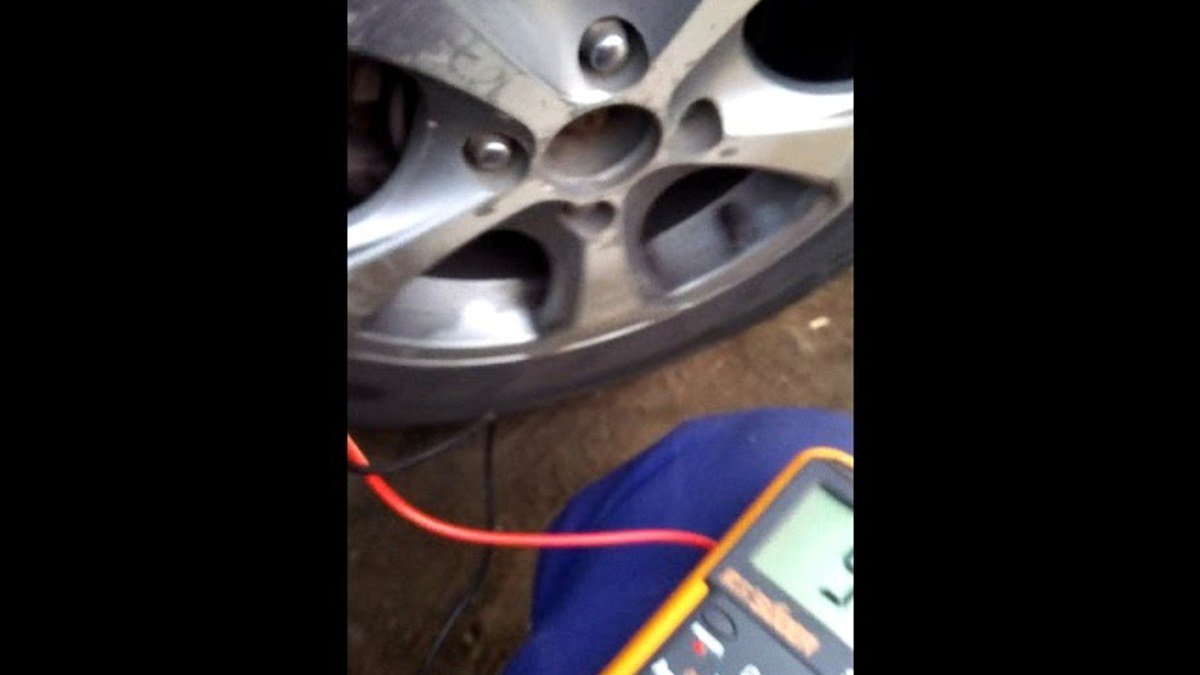
Power supply test in 4 steps:
- Turn the ignition to the “on” position without starting the engine.
- Set the multimeter to DC voltage (VDC) on the 20V range.
- Connect the red probe to the sensor power supply wire and the black probe to a ground point.
- Confirm the supply voltage reads between 11.5V and 12.5V.
Signal output test in 3 steps:
- Keep the ignition on and set the multimeter to DC voltage.
- Connect the probes to the signal wire and the ground wire of the sensor.
- Slowly rotate the wheel and observe the voltage. It should toggle between 0V and 5V as the wheel turns.
What DC Voltage Should an Active ABS Sensor Signal Produce?
An active ABS sensor signal toggles between 0V and 5V DC as the wheel rotates. A signal that remains fixed at 0V or 5V without toggling indicates a faulty sensor or a damaged tone ring.
How Do You Test ABS Sensor Wiring Continuity With a Multimeter?
Testing ABS sensor wiring continuity requires 3 steps:
- Disconnect the sensor connector at the wheel and the ABS module connector at the control unit.
- Set the multimeter to the continuity or resistance setting.
- Touch 1 probe to the sensor wire pin at the wheel end and the other probe to the corresponding pin at the module end.
A reading below 1 ohm confirms continuity. An open line (OL) reading confirms a broken wire.
Test both wires in the sensor harness individually. Also measure resistance between the 2 wires. A reading below 10,000 ohms between 2 separate wires indicates an unwanted short circuit.
What Are the Signs of a Faulty ABS Sensor Wiring Harness?
4 signs indicate a faulty ABS sensor wiring harness:
- Corroded or green-tinted connector pins at the sensor or module end.
- Chafed or cracked wire insulation near the wheel arch or suspension components.
- Intermittent ABS warning light that clears after the vehicle warms up.
- Resistance readings above 1 ohm on the continuity test between sensor and module.
What Do the 3 ABS Sensor Multimeter Test Results Mean?
The table below defines the expected readings and fault conditions for each test method:
| Test Method | Healthy Reading | Fault Reading | Diagnosis |
|---|---|---|---|
| Resistance (passive sensor) | 800 to 2,000 ohms | Below 800 ohms or OL | Short circuit or broken coil |
| AC voltage output (passive) | 0.2V to 1.5V AC | 0V at all speeds | Failed sensor or open circuit |
| DC supply voltage (active) | 11.5V to 12.5V | Below 10V or 0V | Wiring or fuse fault |
| DC signal output (active) | Toggles 0V to 5V | Fixed at 0V or 5V | Faulty sensor or damaged tone ring |
| Wiring continuity | Below 1 ohm | Open line (OL) | Broken wire in harness |
When Should You Replace an ABS Sensor Based on Multimeter Results?
Replace the ABS sensor when multimeter testing produces any of the following results:
- Resistance reads below 800 ohms or shows an open line on a passive sensor.
- AC voltage output reads 0V at all wheel rotation speeds on a passive sensor.
- DC signal does not toggle between 0V and 5V on an active sensor.
- Continuity testing reveals an open circuit in the sensor wiring harness.
ABS sensor replacement costs range from $20 to $100 per sensor for parts. Labor costs range from $50 to $150 per wheel depending on vehicle access and model. Testing with a multimeter before replacing saves between $50 and $300 by confirming the sensor is the source of the fault before ordering parts.

Jimmy O’Riley is a UK-based mobile mechanic and automotive diagnostic specialist operating out of Bedfordshire, England. He founded O’Rileys Autos in 2011 with a focus on bringing professional vehicle repairs directly to customers at their homes and workplaces.
With over a decade of hands-on experience, Jimmy specializes in ABS diagnostics, brake system repairs, diesel emissions faults, and DPF cleaning. He is recognized across the UK and Ireland as one of the leading specialists in vehicle braking and emissions systems, earning the title “The DPF King” from his growing online audience.
Jimmy documents real-world automotive repairs through his YouTube channel, which has accumulated over 97,000 subscribers and nearly 2,000 published repair videos. His content covers ABS fault diagnosis, wheel speed sensor testing, brake module replacement, and roadside repair procedures across a wide range of vehicle makes and models.
He is active on YouTube, Instagram, and Facebook under O’Rileys Autos.