
Planetary Gearbox: How It Works, Gear Ratio Formulas, and Where It’s Used
What Is a Planetary Gearbox?
A planetary gearbox is a gear system built around a central sun gear, planet gears, and a ring gear, all connected by a rotating carrier. It is also called an epicyclic gearbox. A well-documented early example is the Ford Model T’s transmission, which used a two-speed planetary gearset from 1908 to 1927.
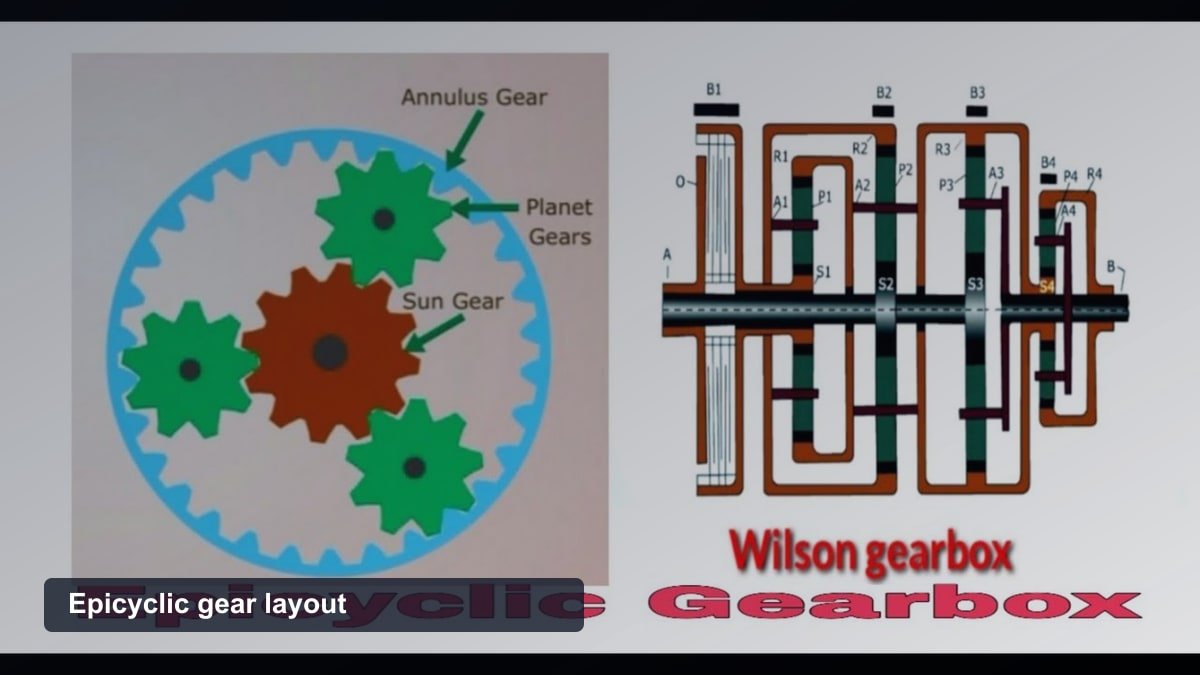
The sun gear sits at the center of the assembly. Planet gears mesh with the sun gear and revolve around it, similar to planets orbiting a star, which gives the system its name. A carrier holds the planet gears in place and lets them rotate on their own axles while orbiting the sun. An outer ring gear, with teeth cut into its inner surface, surrounds and meshes with the planet gears. Power can enter or exit through the sun gear, the ring gear, or the carrier, with the remaining member either fixed or free.
How Does a Planetary Gearbox Work?
A planetary gearbox works by holding one of its three main members fixed while power flows in through a second member and out through the third, with the planet gears transferring load between them.
For example, if the ring gear stays fixed, the sun gear can serve as the input. Turning the sun gear drives the planet gears, which walk around the inside of the stationary ring gear, carrying the carrier around with them at a reduced speed. Because three or more planet gears usually share the load at once, each individual tooth carries less force than it would in a simple two-gear pair, which spreads wear evenly across the gear set.
What Are the Main Components of a Planetary Gearbox?
A planetary gearbox has four main components: a sun gear, planet gears, a planet carrier, and a ring gear.
- Sun gear: the central gear, usually the smallest, positioned along the main axis.
- Planet gears: three or more gears that mesh with the sun gear and the ring gear at the same time.
- Planet carrier: the frame that holds the planet gears in place and allows them to rotate individually while orbiting the sun gear.
- Ring gear: the outer gear, with teeth on its inner surface, that surrounds and meshes with the planet gears.
What Is the History of the Planetary Gearbox?
The planetary gearbox traces back to the Antikythera mechanism, an ancient Greek astronomical calculator dated to around the 2nd century BC and named after the island where it was recovered from a shipwreck in 1901.
Epicyclic gearing resurfaced in 1781, when James Watt patented a sun-and-planet gear to convert the reciprocating motion of his steam engines into rotary motion, working around a rival’s existing crank patent. In 1841, Cambridge engineer Robert Willis published Principles of Mechanism, which introduced a general kinematic formula for calculating the speed relationships in an epicyclic gear train, still known today as the Willis equation. Sturmey-Archer applied the concept to a multi-speed rear bicycle hub in 1902.
Planetary gearing entered mass production with the 1908 Ford Model T, which used a driver-operated, two-speed planetary transmission for its entire 19-year production run. General Motors’ Oldsmobile division went further in 1939, introducing the Hydra-Matic for the 1940 model year: the first mass-produced fully automatic transmission, combining planetary gearsets with a fluid coupling instead of a friction clutch. Later compound planetary designs, such as the Ravigneaux gearset, with a patent application filed in 1949, packed multiple gear ratios into a single planetary unit, a design still found in automatic transmissions today.
How Do You Calculate a Planetary Gearbox’s Gear Ratio?
A planetary gearbox’s gear ratio depends on which of its three members stays fixed, since each configuration produces a different mathematical relationship between input and output speed.
| Fixed Member | Input / Output | Gear Ratio Formula | Typical Range |
|---|---|---|---|
| Ring gear | Sun in, carrier out | 1 + (ring teeth ÷ sun teeth) | Greater than 2:1 |
| Sun gear | Ring in, carrier out | 1 + (sun teeth ÷ ring teeth) | Between 1:1 and 2:1 |
| Carrier | Sun in, ring out | −(sun teeth ÷ ring teeth) | Reverses direction |
Holding the ring gear fixed produces the largest reduction ratios, which is why this configuration is the most common choice in industrial gear reducers. Holding the carrier fixed reverses the direction of rotation between the sun and ring gears, a property used to provide a reverse gear in some transmissions. For the gears to mesh correctly, the ring gear’s tooth count must equal the sun gear’s tooth count plus twice the tooth count of one planet gear.

What Are the Advantages of a Planetary Gearbox?
A planetary gearbox offers five main advantages over a simple parallel-shaft gearbox: high torque density, load sharing, coaxial shafts, multiple ratios from one unit, and smooth operation.
- High torque density, delivering more torque per unit of size and weight than a comparable simple gear train.
- Load sharing across three or more planet gears, which reduces wear on any single gear and extends service life.
- Coaxial input and output shafts, keeping the drive line straight instead of offset.
- Multiple gear ratios available from one housing, simply by changing which member is held fixed.
- Smoother, quieter operation, since the load is distributed evenly around the gear set.
What Are the Disadvantages of a Planetary Gearbox?
A planetary gearbox has four main drawbacks: manufacturing complexity, cost, heat buildup, and servicing difficulty.
- Complex design and tight manufacturing tolerances raise production cost compared to simple gear trains.
- Uneven spacing of the planet gears can create imbalance, leading to premature wear if manufacturing precision slips.
- The compact housing makes heat dissipation more difficult under continuous heavy load, sometimes requiring additional cooling.
- Internal components are harder to inspect and service than an exposed parallel-shaft gear train.

How Does a Planetary Gearbox Compare to a Parallel-Shaft Gearbox?
A planetary gearbox differs from a parallel-shaft gearbox mainly in size for a given torque rating, since load sharing across multiple planet gears allows a smaller housing.
| Feature | Planetary Gearbox | Parallel-Shaft Gearbox |
|---|---|---|
| Shaft alignment | Coaxial (in line) | Offset |
| Torque density | High | Lower for the same size |
| Load path | Shared across 3 or more planet gears | Carried by a single gear pair per stage |
| Manufacturing cost | Higher | Lower |
| Typical efficiency per stage | Around 97% to 99% | Around 98% to 99% |
| Common uses | Automatic transmissions, robotics, wind turbines | Conveyors, simple industrial drives |
Where Are Planetary Gearboxes Used?
Planetary gearboxes appear in automotive, renewable energy, and industrial equipment, wherever a design needs high torque in a compact, coaxial package.
- Automotive: automatic transmissions, hybrid and electric vehicle reduction drives.
- Renewable energy: wind turbine gearboxes, which step up the slow rotation of the rotor to the higher speed a generator needs.
- Robotics and aerospace: precise, compact actuators for robotic arms, aircraft control systems, and surgical devices.
- Industrial machinery: conveyors, mixers, cranes, and mining equipment that need high torque in limited space.
- Consumer products: power tool gear reducers and internal-gear bicycle hubs.
For technical background, see epicyclic gearing reference.
How Efficient Is a Planetary Gearbox?
A single-stage planetary gearbox is typically 97% to 99% efficient, though efficiency drops as more stages are added to reach higher reduction ratios.
Each meshing stage loses a small amount of energy to friction, so a multi-stage unit built for a very high ratio compounds that loss. As an illustration, one manufacturer reports a multi-stage planetary gearbox with a 102:1 ratio achieving close to 90% forward efficiency. Single-stage units used for more modest ratios stay close to the top of the efficiency range.
How Is a Planetary Gearbox Maintained?
A planetary gearbox needs periodic lubrication checks, wear inspection, and prompt attention to unusual noise to avoid premature failure.
- Change or replenish gear oil on the manufacturer’s recommended schedule, since the compact design relies on consistent lubrication.
- Inspect planet gears and the carrier periodically for uneven wear, which can signal a manufacturing or alignment issue.
- Listen for unusual noise or vibration; both often indicate a worn bearing or gear tooth damage.
- Check mounting bolts and housing seals for looseness or leaks during routine service.
- Monitor operating temperature under continuous load, since the compact housing dissipates heat less readily than an open gear train.
Why Choose a Planetary Gearbox?
A planetary gearbox is worth choosing when a design needs high torque in limited space, with load sharing and coaxial shafts outweighing its higher manufacturing cost.
Automotive engineers rely on it for automatic and electric-vehicle transmissions. Wind turbine and robotics designers rely on it for the same reason: a compact housing that still handles heavy loads. Where space is not constrained and cost matters more than torque density, a simple parallel-shaft gearbox often remains the more practical choice.
Common Questions About Planetary Gearboxes
Is a Planetary Gearbox the Same as an Epicyclic Gearbox?
Yes. Planetary gearbox and epicyclic gearbox describe the same design; the terms are used interchangeably in engineering literature.
Can a Planetary Gearbox Increase Speed Instead of Reducing It?
Yes. Reversing the input and output members turns a speed-reducing planetary gearbox into a speed increaser, which is how a wind turbine gearbox steps up rotor speed for the generator.
How Many Planet Gears Does a Typical Planetary Gearbox Have?
Most designs use three or four planet gears. Higher-torque applications sometimes use five or more, as long as the tooth counts and spacing allow even meshing around the sun gear.
Sources
- Wikipedia: Ravigneaux Planetary Gearset
- Wikipedia: Hydramatic
- The Henry Ford: Model T Transmission
- tec-science: Transmission Ratios of Planetary Gears (Willis Equation)
- Woodgears: Planetary Gear Ratio Calculations
- Princeton Human Power and Propulsion: The Epicyclic Gearbox
- Sonnax: The Evolution of Automatic Transmissions

Jimmy O’Riley is a UK-based mobile mechanic and automotive diagnostic specialist operating out of Bedfordshire, England. He founded O’Rileys Autos in 2011 with a focus on bringing professional vehicle repairs directly to customers at their homes and workplaces.
With over a decade of hands-on experience, Jimmy specializes in ABS diagnostics, brake system repairs, diesel emissions faults, and DPF cleaning. He is recognized across the UK and Ireland as one of the leading specialists in vehicle braking and emissions systems, earning the title “The DPF King” from his growing online audience.
Jimmy documents real-world automotive repairs through his YouTube channel, which has accumulated over 97,000 subscribers and nearly 2,000 published repair videos. His content covers ABS fault diagnosis, wheel speed sensor testing, brake module replacement, and roadside repair procedures across a wide range of vehicle makes and models.
He is active on YouTube, Instagram, and Facebook under O’Rileys Autos.