Preview
Power Steering: Definition, 3 System Types, How It Works, and Failure Risks
Meta description: Power steering definition, 3 system types, working principle, components, fuel economy data, and failure risks, backed by NHTSA recalls and research.
What Is Power Steering?
Power steering is a system that reduces steering effort by using an external power source to turn the wheels. Other names include power assisted steering (PAS) and steering assist system. External power sources include belt-driven hydraulic pumps, electric motors, and electric pumps in hybrid systems. All modern cars have power steering.
Examples include the 1951 Chrysler Imperial with hydraulic assist, the second-generation Toyota MR2 with electro-hydraulic assist, and the Acura NSX with electric assist.
Who Invented Power Steering?
Francis W. Davis invented the first practical power steering system in 1926, while working as an engineer at the truck division of Pierce-Arrow. General Motors rejected his hydraulic system because of production cost. Chrysler introduced power steering in a passenger car 25 years after the invention. The Chrysler system, named Hydraguide, was based on expired Davis patents.
For related reading, see Inner Steering Rod: Definition, 3 Functions, 6 Failure Symptoms, and 7 Replacement Steps. The same maintenance context also connects with Inner Steering Rod.
The table below lists 5 power steering milestones from 1876 to 1990.
| Year | Milestone | Entity |
|---|---|---|
| 1876 | First power steering system installed on an automobile | Fitts |
| 1926 | First practical power steering system invented | Francis W. Davis, Pierce-Arrow |
| 1951 | First commercially available passenger car system (Hydraguide) | Chrysler Imperial |
| 1952 | Power steering system introduced | General Motors, Cadillac |
| 1990 | Electro-hydraulic power steering introduced | Toyota, second-generation MR2 |
The 1876 entry comes from amklassiek.nl. The other entries come from Wikipedia and its 1990 MR2 entry.
How Does Power Steering Work?
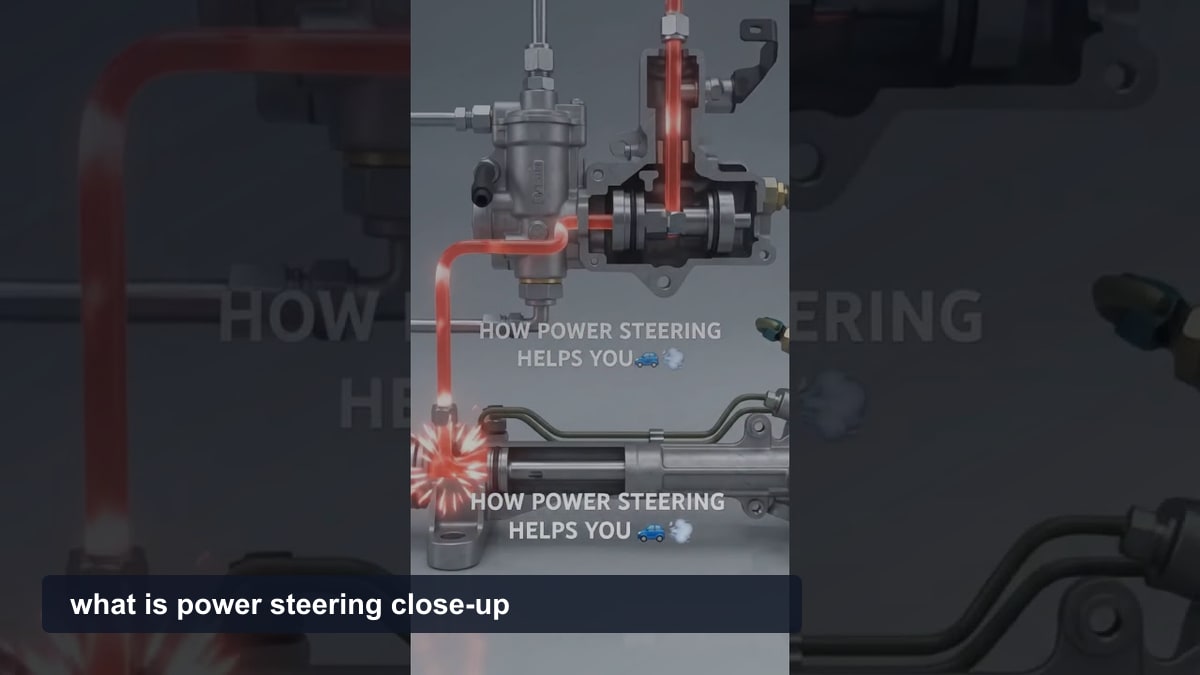
Power steering works by detecting steering wheel input and adding assist force in the direction of the turn. A hydraulic system works in 4 steps:
- The engine belt drives the pump.
- The pump supplies hydraulic pressure to the system.
- Steering wheel torque creates unequal pressure in the 2 hydraulic lines.
- The unequal pressure assists the wheels in turning the intended direction.
Straight-line driving gives equal pressure to both sides of the steering gear. A relief valve bleeds away excess pressure as engine speed increases.

An electric system uses sensors to detect the motion and torque of the steering column, and a computer applies assist through electric motors. Electric-only systems provide less feedback to the driver, described as a lack of steering feel.
What Are the 3 Types of Power Steering?
Power steering has 3 primary types: hydraulic, electro-hydraulic, and electric systems. The table below compares the types by assist source, drive, and key characteristic.
| Type | Assist source | Drive | Key characteristic |
|---|---|---|---|
| Hydraulic power steering (HPS) | Hydraulic pressure | Engine-driven belt pump | Pump runs continuously and wastes fuel when assist is not needed |
| Electro-hydraulic power steering (EHPS) | Hydraulic pressure | Electric motor-driven pump | Same feel as hydraulic power steering |
| Electric power steering (EPS) | Electric motor | Electric motor with sensors and a computer | Less feedback to the driver |
Electro-hydraulic systems use hydraulic assist technology with pressure supplied by an electric motor instead of a belt. They provide the same feel as a conventional hydraulic system. The pump in a hydraulic system works continuously, including when assist is not in use, which wastes horsepower and fuel.
What Are the Main Components of a Power Steering System?
A power steering system has different components in hydraulic and electric designs. The hydraulic design has 6 components:
- Pump: supplies hydraulic pressure to the system.
- Reservoir: stores the power steering fluid.
- Hydraulic lines: carry equal or unequal pressure to both sides of the steering gear.
- Rotary valve: distributes flow to the two sides of the rack piston.
- Flow control valve: limits system flow and pressure.
- Hydraulic cylinder: applies force to the steering gear as a double-acting cylinder.
The electric design adds 5 components: sensors, wires, actuators, motors, and an electronic control unit.
For a reliable reference point, see NHTSA recalls and vehicle safety.
Related reading: [internal link: Power Steering Pump]
How Much Fuel Does Electric Power Steering Save?
Electric power steering saves 1.7% to 4% of fuel compared with hydraulic power steering, based on a Springer-published study and TRW Automotive estimates. A conventional system is driven directly by the engine crankshaft with a belt. An electric motor uses power only during steering. TRW reports 75% to 85% lower energy consumption than hydraulic systems. The table below lists 4 results.
| System | Fuel economy improvement over hydraulic power steering | Basis | Source |
|---|---|---|---|
| Electro-hydraulic (EHPS) | 1% | FTP-75 driving cycle, experiment and simulation | Springer-published study |
| Electric (EPS) | 1.7% | FTP-75 driving cycle, experiment and simulation | Springer-published study |
| Electric (EPS) | 3% to 4% | Manufacturer estimate | TRW Automotive |
| Electric powered hydraulic (EPHS), loaded commercial vehicles | 3% to 6% | Field trials | SAE International |
The Springer-published study reports the 1% and 1.7% gains. TRW reports the 3% to 4% estimate. The SAE field trials report the 3% to 6% gain.
What Fluid Does Hydraulic Power Steering Use?
Hydraulic power steering uses power steering fluid, which consists of base oil and an additive package. Some manufacturers switched from automatic transmission fluid to dedicated power steering fluid because of seal and material compatibility. Using an incorrect fluid damages the steering system.
What Happens When Power Steering Fails?
When power steering assist fails, manual steering remains, but steering effort increases, especially at low speeds, according to General Motors recall documents. The increased effort raises the risk of a crash. A malfunction indicator light and a chime warn the driver when assist is lost. The table below lists 3 NHTSA recall cases involving electric power steering.
| Recall | Date | Manufacturer | Vehicles affected | Cause | Result |
|---|---|---|---|---|---|
| FCA S19 | April 2016 | FCA US | 442 Ram 1500 trucks, 2015 to 2016 | Contamination on the EPS control circuit board | Loss of power steering assist |
| 17V382 | June 2017 | General Motors | 6,204 vehicles | Corrosion of the connector between the EPS module and the torque sensor | Loss of EPS assist |
| 23V-496 | July 2023 | Nissan North America | Not stated | EPS torque sensor disables assist | Loss of power steering assist |
The data comes from Automotive Fleet’s report on the Ram recall, NHTSA recall 17V382, and NHTSA recall 23V-496.
How Much Does Power Steering Repair Cost in Nigeria?
Power steering repair or pump replacement costs ₦50,000 to ₦150,000 in Nigeria, according to Naira Autos.
Related reading: [internal link: Power Steering Pump Replacement Cost]
What Are People Also Asking About Power Steering?
What Does Power Steering Do?
Power steering reduces the effort needed to turn the steering wheel.
Do All Cars Have Power Steering?
All modern cars have power steering.
Can a Car Be Driven Without Power Steering Assist?
A car keeps manual steering, but the steering effort increases, especially at low speeds.
What Is the Difference Between Hydraulic and Electric Power Steering?
Hydraulic power steering uses pressure generated by a pump, and electric power steering uses an electric motor.
What Is Power Steering?
Power steering is a system that reduces steering effort by using an external power source to turn the wheels.