
Continuously Variable Transmission (CVT): How It Works and 5 Common Problems
A continuously variable transmission, or CVT, is a type of automatic gearbox that shifts through an infinite range of ratios instead of a fixed set of gears. Two variable-diameter pulleys connected by a steel belt or chain create the ratio change, which keeps the engine near its most efficient RPM at any road speed. Automakers like Toyota, Honda, Subaru, and Nissan build CVTs into most of their compact and mid-size lineups, since the design can improve fuel economy by up to 10% over a traditional stepped automatic.
What Is a Continuously Variable Transmission?
A continuously variable transmission is an automatic gearbox with no fixed gears, capable of an infinite number of ratios within a set range. Unlike a traditional automatic, which steps through a defined number of gears (commonly 6 to 10 in modern vehicles), a CVT changes ratio smoothly and continuously as road speed and throttle input change.
The core idea dates back centuries. Leonardo da Vinci sketched a variable-ratio drive system in 1490, and the concept reached its first patent in 1886. Modern automotive CVTs, using steel belts and hydraulically controlled pulleys, became common in mainstream cars starting in the late 1990s and early 2000s. For example, the 2013 Honda Accord introduced a CVT option that replaced its previous 5-speed automatic and delivered a real-world fuel economy gain.
How Does a CVT Work?
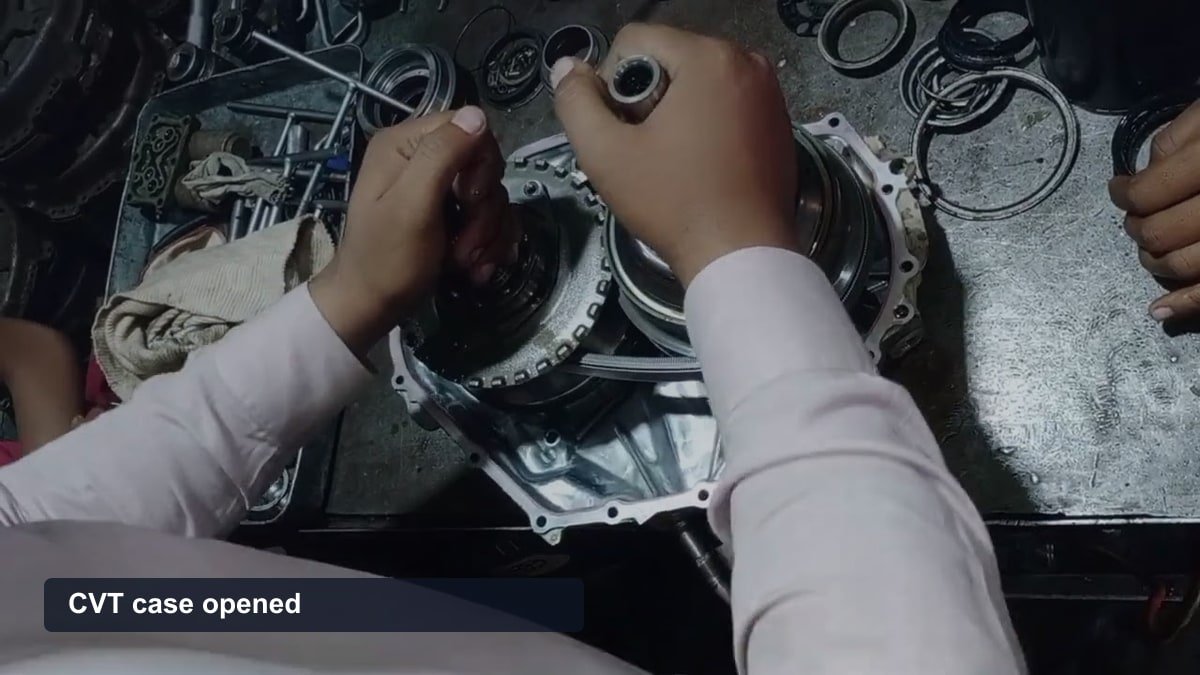
A CVT works through two variable-diameter pulleys connected by a steel belt or chain. Each pulley is built from two cone-shaped halves that slide together or apart, which changes the effective diameter the belt rides on and, with it, the drive ratio.
When the drive pulley’s halves squeeze together, the belt rides higher and the ratio favors torque for acceleration from a stop. As the halves spread apart and the driven pulley’s halves close, the ratio shifts toward higher road speed and better efficiency. Toyota’s Direct Shift-CVT, for example, spans a ratio range of about 0.4:1 to 2.5:1, a spread of roughly 6:1. A hydraulic control system adjusts both pulleys continuously, typically at a line pressure between 30 and 60 bar, to match engine output to driving conditions.
(Image suggestion: diagram of CVT pulleys and belt system. Alt text: “Diagram of CVT pulleys and belt showing how gear ratio changes.”)
What Are the Different Types of CVT?
Automakers and equipment manufacturers use five main CVT designs, each suited to a different torque range and application. The table below compares them.
| Type | Mechanism | Best Suited For |
|---|---|---|
| Belt-driven (pulley) | Steel push belt between two variable-diameter pulleys | Compact and mid-size passenger cars |
| Chain-driven (pulley) | Multi-link steel chain instead of a belt, smaller minimum diameter | Larger sedans and SUVs, higher torque |
| Toroidal | Discs and rollers instead of a belt | Higher-torque performance applications |
| Hydrostatic | Variable hydraulic pump and motor, no belt or pulley | Tractors, industrial, and construction equipment |
| eCVT (power-split) | Planetary gearset with electric motor-generators, no belt | Hybrid and plug-in hybrid vehicles |
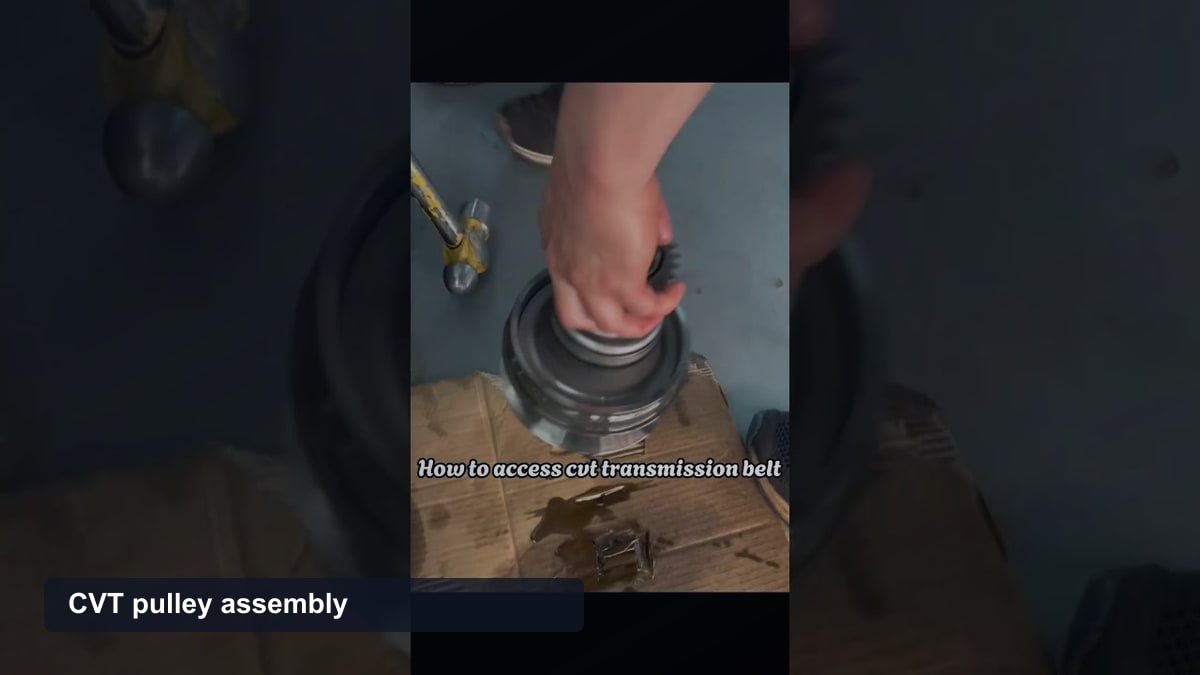
Belt and chain-driven CVTs dominate the passenger car market, since they cost less to produce and handle typical car engines well. A toroidal CVT handles more torque because its discs and rollers don’t rely on belt-to-pulley friction, but the added complexity has kept it out of mainstream production.
What Are the Advantages of a CVT?
A CVT’s biggest advantage is fuel economy. Since it has no fixed gear steps, the transmission keeps the engine near its ideal RPM at any road speed, which improved real-world fuel economy by up to 10% when Honda replaced the 5-speed automatic in its 2013 Accord.
A CVT also delivers power without interruption. A traditional automatic briefly interrupts power during a gear change, but a CVT’s continuous ratio shift removes that shift shock and produces smoother acceleration from a stop.
What Are the Disadvantages of a CVT?
A CVT’s belt or chain can only transmit as much torque as its material strength allows, which limits pulley-based CVTs in high-torque trucks and performance vehicles. Many drivers also notice a rubber-band driving feel, since engine RPM can climb ahead of an equivalent increase in road speed.
Several automakers now program simulated shift points into the CVT’s software, spacing out 6 to 8 preset ratios to mimic a traditional automatic’s shift feel. Subaru’s Lineartronic, Nissan’s Xtronic, and Honda’s G-Design Shift all use this approach. Repairs also cost more than a traditional automatic, since a damaged belt or chain typically forces a full transmission replacement instead of an internal rebuild.
Which Vehicles Use a CVT?
Automakers rely on two main CVT categories: pulley-based units in gasoline models and eCVTs paired with hybrid drivetrains. Common applications include:
- Subaru Outback, Forester, Crosstrek, and Ascent, using the Lineartronic CVT
- Toyota and Lexus hybrids, including the Camry Hybrid, RAV4 Hybrid, RX 350h, and NX 450h+, using an eCVT
- Honda Civic, Accord, and CR-V, using a belt-and-pulley CVT with G-Design Shift
- Nissan Altima, Rogue, Sentra, and Murano, using the Jatco-built Xtronic CVT
Subaru discontinued the Legacy sedan in 2025 after 35 years and 1.3 million US sales, though its Lineartronic CVT remains standard across the rest of the lineup.
What Transmission Fluid Does a CVT Use?
A CVT uses CVT fluid (CVTF), a specialized formula that differs from standard automatic transmission fluid and should never substitute for it. Manufacturer-specific versions include Nissan NS-2 and NS-3, Toyota CVT FE, Honda HCF-2, and ZF LifeguardFluid CVT.
CVTF prioritizes friction control between the belt and pulleys, while standard ATF is formulated for the clutch packs in a traditional automatic. Most manufacturers recommend a fluid change every 30,000 to 60,000 miles, since heat and fluid breakdown drive most of the wear inside a CVT. See our CVT Fluid Compatibility Guide for a full breakdown by make and model.
What Are Common CVT Problems?
A CVT is efficient, but five failure points account for most of its repairs.
- Shuddering during acceleration. A worn belt, chain, or degraded fluid causes vibration between roughly 20 and 50 mph, a symptom widely reported in early Nissan Xtronic CVTs and confirmed through multiple technical service bulletins and class-action settlements. See our Nissan CVT Problems Guide for model-specific details.
- Overheating. A CVT runs at higher internal pressures than a traditional automatic, and inadequate cooling breaks down the fluid faster, which accelerates wear on the belt and pulleys.
- Delayed or hesitant acceleration. Low fluid pressure or a failing valve body delays power delivery when pulling away from a stop.
- Belt or chain slippage. Worn pulley surfaces or degraded fluid let the belt slip under load, which reduces power transfer and speeds up wear.
- Complete transmission failure. Since a CVT relies on precise clearances between the belt and pulleys, significant wear usually requires a full replacement rather than an internal rebuild.

(Image suggestion: cutaway view of a CVT unit. Alt text: “Cutaway view of a CVT transmission showing the belt and pulleys.”)
For technical background, see continuously variable transmission overview.
How Does a CVT Compare to a Traditional Automatic Transmission?
A CVT and a traditional automatic both shift without driver input, but they reach that result through different hardware. The table below compares their core traits.
| Spec | CVT | Traditional Automatic |
|---|---|---|
| Gear ratios | Infinite, within a set range | Fixed number of gears, commonly 6 to 10 |
| Shift feel | Seamless, no shift shock | Distinct shifts between gears |
| Fuel economy | Up to 10% better | Baseline |
| Torque capacity | Lower, limited by belt or chain strength | Higher, suited to towing and high-horsepower engines |
| Repair approach | Often a full replacement | Often rebuildable |
| Common use | Compact and mid-size cars, hybrids | Trucks, SUVs, performance vehicles |
Frequently Asked Questions About CVTs
Can a CVT be repaired, or does it need to be replaced?
Minor CVT issues, like a failed solenoid or a software update, can often be repaired, but belt or chain damage usually requires a full transmission replacement rather than a rebuild.
Do CVTs use gears?
A pulley-based CVT has no fixed gears. It uses two variable-diameter pulleys and a belt or chain to create a continuous range of ratios instead.
Is a CVT the same as an automatic transmission?
A CVT is technically a type of automatic transmission, since it shifts ratios without driver input, but it uses pulleys instead of the fixed gear sets found in a traditional automatic.
How often should CVT fluid be changed?
Most manufacturers recommend a CVT fluid change every 30,000 to 60,000 miles, though the exact interval varies by make and model.
Is a CVT Right for Your Vehicle?
A CVT gearbox fits daily-driven compact and mid-size cars, hybrids, and any build where fuel economy matters more than towing capacity or peak horsepower. Its stepless power delivery and 10% fuel economy advantage make it the standard choice for automakers like Toyota, Honda, and Subaru.
A traditional stepped automatic remains the better fit for trucks, SUVs, and high-torque performance builds, since its fixed gears handle more load and cost less to rebuild after a failure. For a heavy-duty stepped automatic built for towing, see our 4L80E Transmission Guide. Between the two, the deciding factor comes down to how the vehicle gets used: steady commuting favors a CVT, while towing and hard acceleration favor a traditional automatic.

Jimmy O’Riley is a UK-based mobile mechanic and automotive diagnostic specialist operating out of Bedfordshire, England. He founded O’Rileys Autos in 2011 with a focus on bringing professional vehicle repairs directly to customers at their homes and workplaces.
With over a decade of hands-on experience, Jimmy specializes in ABS diagnostics, brake system repairs, diesel emissions faults, and DPF cleaning. He is recognized across the UK and Ireland as one of the leading specialists in vehicle braking and emissions systems, earning the title “The DPF King” from his growing online audience.
Jimmy documents real-world automotive repairs through his YouTube channel, which has accumulated over 97,000 subscribers and nearly 2,000 published repair videos. His content covers ABS fault diagnosis, wheel speed sensor testing, brake module replacement, and roadside repair procedures across a wide range of vehicle makes and models.
He is active on YouTube, Instagram, and Facebook under O’Rileys Autos.