
The BMW 3 Series is on a driveway in Kempston, and the owner is standing next to me showing dashcam footage on his phone. Last Tuesday, the A421, nearly into the back of a skip lorry. The ABS light has been on since February.
He wants to know if his insurance will cover him if something had happened. I told him what he actually needed to hear. In the UK, the answer depends on what he knew and when he knew it.
Once a warning light has been on long enough for you to notice it, the insurer's position changes. They do not have to prove the fault caused the accident outright. They need to show you were driving a vehicle in a condition you knew to be defective.
Under Section 40A of the Road Traffic Act 1988, using a vehicle in a dangerous condition on a public road is a criminal offence. That applies whether the journey was five minutes or five hundred miles. A faulty ABS system qualifies.
The MOT angle is the one most people miss entirely. An ABS warning light on the dashboard is an automatic MOT failure under current DVSA standards. If the fault develops after a test, the certificate covers the day it was issued nothing more.
I have seen people carry a valid MOT certificate as though it is a legal shield. It is documentation that the car passed a test on a specific day. What happens after that day is not its concern.
Americans started turning up in my YouTube comments a couple of years ago asking the same question from their side of it. The Federal Motor Vehicle Safety Standard 135 covers passenger car braking in the US. Its position on knowingly driving with a defective system is not far from ours. The civil liability route, however, is considerably wider.
In most US states, a doctrine called negligence per se applies when you drive with a known safety defect. It means the defect itself becomes evidence of fault. You no longer need to prove bad driving knowing about it and driving anyway is enough.
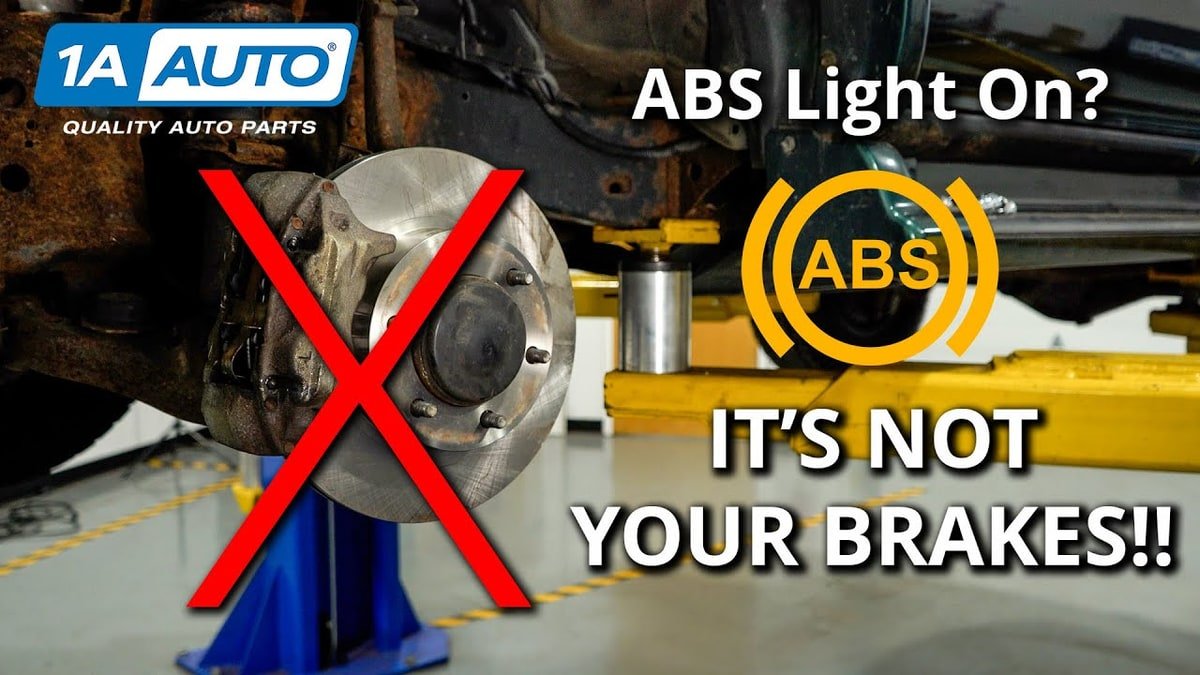
Some US states have annual inspection programmes that function similarly to our MOT. Virginia, New York, Pennsylvania they all run safety checks that include brake system warning lights. Fail those, drive away, hit someone, and the inspection record becomes part of the case against you.
Back to the BMW in Kempston, and the diagnostic bit that matters here. The owner assumed the fault code would at least tell us where we stood. I pulled the live data alongside it, because the two screens were already contradicting each other before I had been connected three minutes.
The code pointed at the rear-right wheel speed sensor. Live data showed that sensor reading correctly at low speed erratic only above 40mph and only under braking load. When I listened to the pump cycle during the key-on self-test, there was a hesitation in it an irregular double-beat where the sound should be clean.
The modulator connector on that car always fights you. Corroded around the pin housing the way anything through a Bedfordshire winter gets. When I got into the hydraulic circuit, the solenoid plunger was gummed with residue from brake fluid degrading in a sealed block.
The code was pointing at a symptom. The solenoid was the fault. If you went to a garage that stopped at the stored code, you would have been heading toward a sensor replacement that fixed nothing.
That changes the legal picture. A sticking solenoid affects more than the ABS cut-in function it can create uneven brake pressure distribution across the axle. The car was not braking consistently, and he had been driving it that way since February.
I understand why the light gets ignored. The car stopped every single day between February and last Tuesday, and nothing felt dramatically wrong until it had to stop hard. That gap between the warning and the consequence is exactly what makes these situations so difficult.
What frustrates me not about this owner, but about how the industry handles it is the silence around legal risk. People pay for a code read, get told it is a wheel speed sensor, buy the part online. The underlying fault sits there getting worse. Nobody mentions what it means to drive a car with a brake system warning active.
The thing that stays with me from that driveway in Kempston is the dashcam clip. He showed it to me to explain what had happened. That footage would have been the first thing his insurer requested, and it shows exactly when the pedal went soft.

Jimmy O’Riley is a UK-based mobile mechanic and automotive diagnostic specialist operating out of Bedfordshire, England. He founded O’Rileys Autos in 2011 with a focus on bringing professional vehicle repairs directly to customers at their homes and workplaces.
With over a decade of hands-on experience, Jimmy specializes in ABS diagnostics, brake system repairs, diesel emissions faults, and DPF cleaning. He is recognized across the UK and Ireland as one of the leading specialists in vehicle braking and emissions systems, earning the title “The DPF King” from his growing online audience.
Jimmy documents real-world automotive repairs through his YouTube channel, which has accumulated over 97,000 subscribers and nearly 2,000 published repair videos. His content covers ABS fault diagnosis, wheel speed sensor testing, brake module replacement, and roadside repair procedures across a wide range of vehicle makes and models.
He is active on YouTube, Instagram, and Facebook under O’Rileys Autos.