
The Astra was on a driveway in Flitwick with its ABS light back on, three weeks after another technician had replaced the right rear wheel speed sensor. The new sensor was sitting there clean and obviously recent. The light had returned within a fortnight of the first visit.
The code on my scan was identical to the one the previous technician had cleared. A C0045, right rear wheel speed sensor circuit fault. Reading that off a screen and ordering a sensor is the kind of diagnosis that happens when someone is working faster than the job allows.
When I pulled the wheel and looked at the reluctor ring on the hub, the problem was obvious. The ring had cracked on the inner face, not visible without removing the wheel and knowing to look for it. The new sensor was reading the ring as accurately as it could. It was reading a broken ring, and reporting exactly that.
The code was correct. The diagnosis that followed from it was not. That gap is the part of this conversation the industry finds uncomfortable, because it does not reduce to a workforce number.
For official safety context, see this reference.
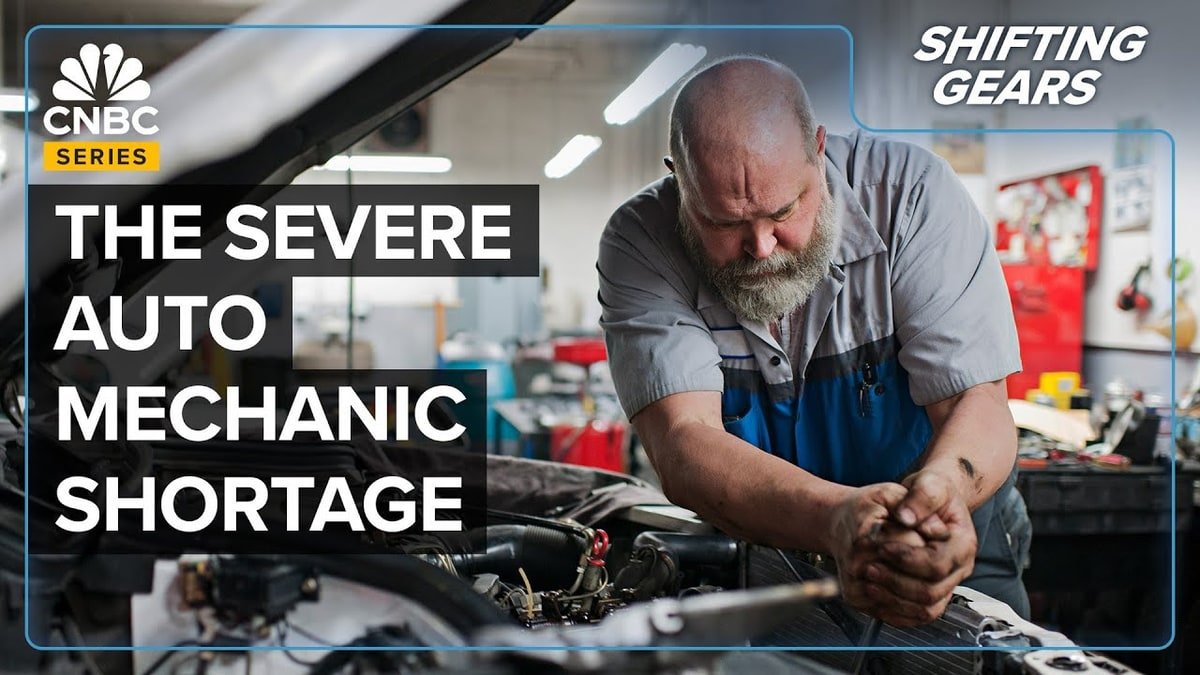
The figure being reported in the US is that the auto repair industry will need sixty-seven thousand new technicians by 2032. Not sixty-seven thousand extra to cover growth. Sixty-seven thousand to cover the gap between the people retiring out of the trade and the people coming into it to take their place.
I see this from Bedfordshire through the comments on the channel, because a significant portion of the people watching are American. They describe waiting weeks for a garage appointment on something that should take an afternoon. Some of them are trying to diagnose their own ABS faults from YouTube because nobody locally can get to them in time. That is not a position anyone should be in with a braking system.
The UK is not running a dramatically different story. The IMI reported a shortage of over one hundred thousand skilled automotive technicians across Britain, and the number has not improved meaningfully since. The sixty-seven thousand figure, as large as it is, was also calculated against a fleet that is being replaced by something considerably more complicated.
A conventional ABS fault on a Vauxhall or a Ford is a complex enough diagnostic task when it is done properly. Add an electric motor managing deceleration and a regen system feeding into the braking circuit at every stop, and you have a different diagnostic environment entirely. The people being trained now will be working on vehicles their training programmes have not fully caught up with.
What concerns me more than the raw shortage number is the quality pressure that shortage creates. When there are not enough technicians to go around, the incentive is to put people through programmes faster and release them earlier than the work actually requires. The Astra in Flitwick was not attended to by a bad person. It was attended to by someone who had not been given enough experience to look past the first code the scanner returned.
The trade does not struggle to attract people because the work is unpleasant. It struggles because entry-level pay is still benchmarked against a time when the diagnostic complexity was a fraction of what it is now. Someone training to work on a modern ABS system, an EV braking integration, or a chassis control network is doing technical work. It deserves to be paid accordingly from the beginning of that career, not after years of proving the point.
The owner of the Astra paid twice for the same job, once for the wrong repair and once for the right one. The total cost to resolve an issue that a thorough first inspection would have found was more than it needed to be. She was patient about it in a way I found uncomfortable.
The apprenticeship model, when it is run properly, is how this gets addressed. You learn the theory alongside someone who has seen these faults accumulate over years on the same roads. That is how you build the pattern recognition a code scanner alone cannot provide.
The American industry is not short of people who could do this work. It is short of the structured environment to bring them up to the level where the work is done correctly.
The reluctor ring on the Astra cost forty-two pounds and an hour of my time. The sensor that did not fix it cost the owner a hundred and thirty. That difference is not a story about parts prices. It is a story about what happens to a trade when it underinvests in the people doing the work for long enough.

Jimmy O’Riley is a UK-based mobile mechanic and automotive diagnostic specialist operating out of Bedfordshire, England. He founded O’Rileys Autos in 2011 with a focus on bringing professional vehicle repairs directly to customers at their homes and workplaces.
With over a decade of hands-on experience, Jimmy specializes in ABS diagnostics, brake system repairs, diesel emissions faults, and DPF cleaning. He is recognized across the UK and Ireland as one of the leading specialists in vehicle braking and emissions systems, earning the title “The DPF King” from his growing online audience.
Jimmy documents real-world automotive repairs through his YouTube channel, which has accumulated over 97,000 subscribers and nearly 2,000 published repair videos. His content covers ABS fault diagnosis, wheel speed sensor testing, brake module replacement, and roadside repair procedures across a wide range of vehicle makes and models.
He is active on YouTube, Instagram, and Facebook under O’Rileys Autos.