Steering Knuckle Explained: 5 Parts, 7 Symptoms, and Replacement Cost
What Is a Steering Knuckle?
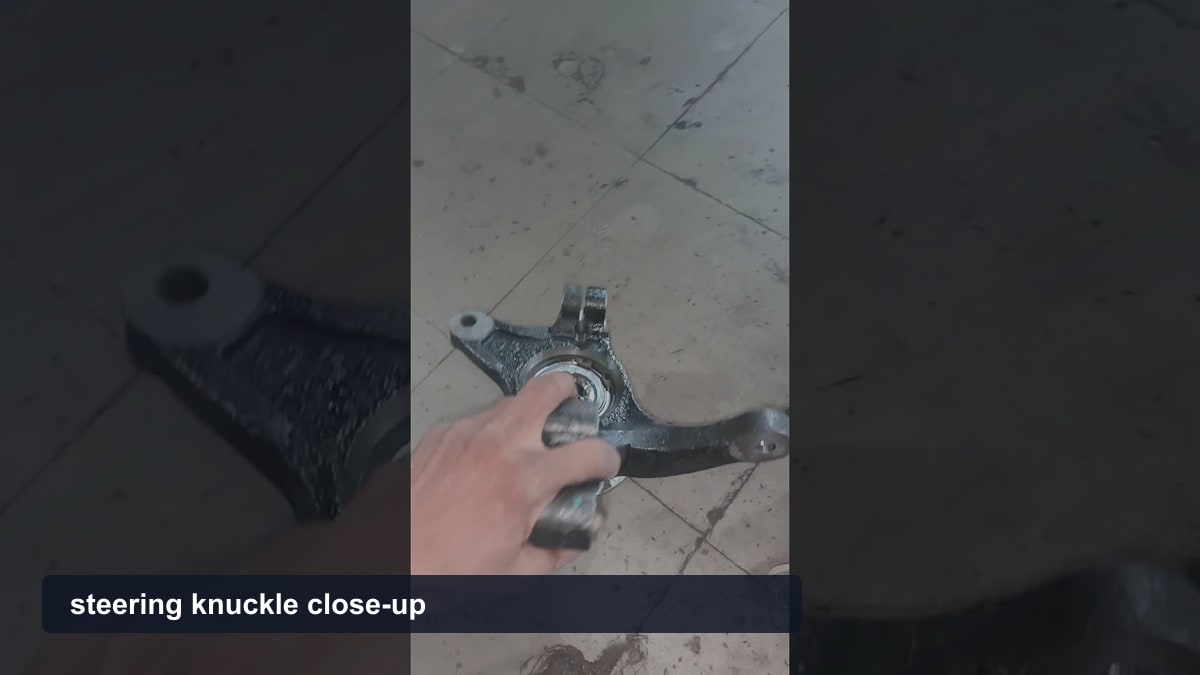
A steering knuckle is the suspension component that holds the wheel hub and bearing and connects them to the suspension and steering systems. It is also called a wheel knuckle, hub carrier, or upright.
Passenger cars, SUVs, pickup trucks, and electric vehicles use steering knuckles. Examples include the Ford Explorer, Audi A4, Tesla Model 3, and Chevrolet Spark. Front knuckles pivot to turn the wheels. Rear knuckles usually hold the rear wheels in a fixed direction.
The spindle is a related term. Some repair manuals use spindle for the whole knuckle. Others use it for the shaft section that carries the wheel hub.
What Does a Steering Knuckle Do?
A steering knuckle supports the wheel and turns it left or right when the driver steers. It performs 5 main functions:
- Support the wheel hub and wheel bearing
- Transfer steering input from the tie rod to the wheel
- Carry suspension loads from the strut or control arms
- Mount brake components, such as the brake caliper
- Hold the wheel at the specified alignment angles
How Does a Steering Knuckle Work?
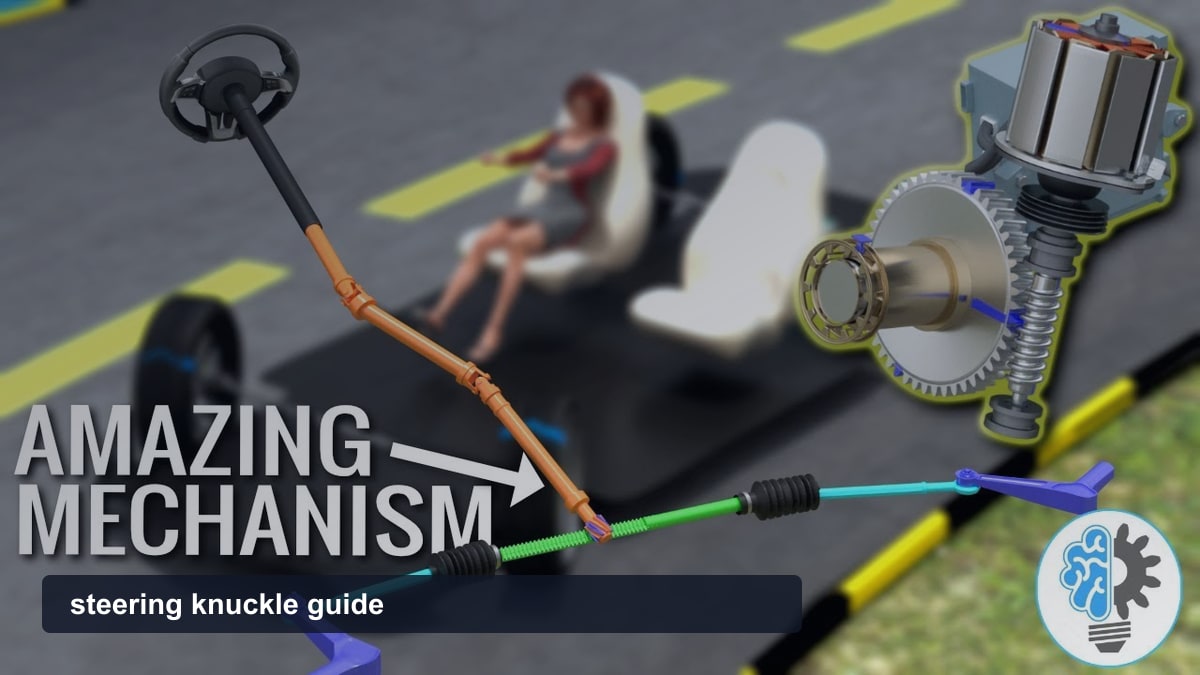
A steering knuckle works by pivoting on its suspension mounting points when the tie rod pushes or pulls the steering arm. The sequence has 5 steps:
- The driver turns the steering wheel.
- The steering rack moves the tie rods.
- The tie rod pushes or pulls the steering arm on the knuckle.
- The knuckle pivots on the lower ball joint and the upper mount.
- The wheel turns in the direction of the steering input.
Which 5 Parts Connect to a Steering Knuckle?
5 main parts connect to a steering knuckle: the wheel hub and bearing, tie rod end, lower control arm, strut or upper control arm, and brake caliper.
The table below defines each part, its attachment point on the knuckle, and its function.
| Connected Part | Attachment Point on the Knuckle | Function |
|---|---|---|
| Wheel hub and bearing | Center bore or mounting flange | Lets the wheel rotate |
| Tie rod end | Steering arm | Transfers steering input from the steering rack |
| Lower control arm | Lower ball joint mount | Links the knuckle to the chassis and allows vertical wheel movement |
| Strut or upper control arm | Upper mount | Carries suspension load and sets the pivot axis |
| Brake caliper | Caliper mounting bosses | Holds the caliper that clamps the brake rotor |
What Types of Steering Knuckles Exist?
Steering knuckles are grouped by 3 criteria: suspension design, axle position, and material.
Which Suspension Designs Use Different Steering Knuckles?
2 common designs use different knuckles: MacPherson strut and double wishbone. The MacPherson strut knuckle bolts to the bottom of the strut. The double wishbone knuckle connects to an upper and a lower control arm.
For related reading, see What Color Is Power Steering Fluid? 6 Colors and Their Meanings. The same maintenance context also connects with What Color Is Power Steering Fluid? 6 Colors and Their Meanings.
Which Axle Positions Use Steering Knuckles?
Steering knuckles are fitted at the front axle and the rear axle. Front knuckles accept steering input from the tie rods. Rear knuckles locate the rear hub and bearing.
What Materials Are Steering Knuckles Made Of?
Steering knuckles are made of 3 main materials: cast iron, forged steel, and cast aluminum. The table below compares each material by manufacturing process and reported characteristics.
| Material | Manufacturing Process | Reported Characteristic |
|---|---|---|
| Cast iron | Sand casting | Generally used for commercial vehicle knuckles, and heavier than aluminum (Aydin et al., 2022) |
| Forged steel | Forging | Superior fatigue behavior compared with cast iron and cast aluminum (Zoroufi and Fatemi, SAE International, 2004) |
| Cast aluminum | Low pressure die casting | Lighter than cast iron, with about 100 times shorter component fatigue life than forged steel at equal stress amplitude (University of Toledo study) |
Forged steel is known for higher fatigue strength than the 2 cast materials. A 2004 SAE International paper by Zoroufi and Fatemi tested forged steel, cast aluminum, and cast iron knuckles. The paper concluded that the forged steel knuckle shows the best fatigue behavior.
A University of Toledo study for the American Iron and Steel Institute (AISI) and the Forging Industry Educational and Research Foundation (FIERF) tested forged steel and cast aluminum knuckles. The forged steel knuckle showed a fatigue life approximately two orders of magnitude (about 100 times) longer at the same stress amplitude. The study also found that design optimization can cut weight by at least 12% and cost by at least 5%.
Aluminum knuckles reduce weight, which supports higher load capacity and lower fuel consumption, according to Aydin and colleagues (2022).
A 2024 numerical study in the World Electric Vehicle Journal by Santana and colleagues examined aluminum metal matrix composite knuckles. The study calculated a weight reduction of about 65% compared with commercial cast iron, for last-mile electric cargo vehicles.
Production examples include the 2017 to 2024 Audi A4, A5, and Q5. These models use forged or cast aluminum knuckles, according to Go-Parts.
What Causes a Steering Knuckle to Fail?
A steering knuckle fails mainly from impact damage, because the component has no moving parts and does not wear out on its own. 5 main causes exist:
- Impact damage from curb strikes and potholes
- Collision damage from accidents
- Corrosion that seizes the wheel bearing inside the knuckle
- Fatigue cracking from repeated loading
- Improper torque on connected fasteners
What Are the 7 Symptoms of a Bad Steering Knuckle?
The 7 main symptoms of a bad steering knuckle are pulling to one side, an off-center steering wheel, steering wheel vibration, uneven tire wear, clunking noises, grinding or humming noises, and visible cracks or bends. Each symptom has a specific cause:
- Pulling to one side: A bent knuckle changes wheel alignment angles and pulls the vehicle toward one side.
- Off-center steering wheel: A bent knuckle shifts steering geometry, so the steering wheel sits off-center during straight driving.
- Steering wheel vibration: A damaged knuckle or a worn wheel bearing sends vibration into the steering wheel.
- Uneven tire wear: A bent knuckle causes tire wear that a wheel alignment does not correct.
- Clunking noises: Clunking usually points to a worn ball joint or a loose part attached to the knuckle.
- Grinding or humming noises: A continuous hum or grind that rises with vehicle speed points to a wheel bearing.
- Visible cracks or bends: Cracks, bends, or heavy corrosion on the knuckle body show structural damage.
Steering wheel vibration has 7 main causes, and a bent knuckle is 1 of them. The article When Steering Wheel Shakes While Driving: 7 Causes, Diagnosis, and Fixes covers each cause.
Does the Knuckle or the Wheel Bearing Cause the Noise?
The wheel bearing or ball joint causes most noises, because the knuckle has no moving parts.
Go-Parts repair guides report that humming and grinding point to the wheel bearing. Clunking points to the ball joint. Replace only the wheel bearing, if the knuckle is undamaged and the only symptom is humming or grinding.
How Is a Bad Steering Knuckle Diagnosed?
A mechanic diagnoses a bad steering knuckle with a visual inspection, a wheel play test, and an alignment check. The process has 6 steps:
- Lift the vehicle and support it on jack stands.
- Rock the wheel at the 12 and 6 o’clock positions to check for ball joint or wheel bearing play.
- Rock the wheel at the 3 and 9 o’clock positions to check for tie rod end play.
- Spin the wheel by hand and listen for roughness from the bearing.
- Inspect the knuckle for cracks, bends, and heavy corrosion.
- Check the alignment readings for angles that stay outside specification after adjustment.
Can You Drive With a Bad Steering Knuckle?
No. A bent or cracked steering knuckle is a safety hazard that can lead to loss of steering control or wheel separation. Tow the vehicle to a repair shop, if a crack or bend is suspected.
For a reliable reference point, see NHTSA recalls and vehicle safety.
How Much Does Steering Knuckle Replacement Cost?
Steering knuckle replacement costs $450 to $1,080+ for one knuckle in the Go-Parts estimates for 3 vehicles, with labor times of 2 to 4 hours.
The table below lists labor time, labor cost, and installed total cost by vehicle, in US dollars.
| Vehicle | Labor Time | Labor Cost | Estimated Installed Total |
|---|---|---|---|
| Buick LaCrosse (2014 to 2019) | 2 to 4 hours | $180 to $350 | $450 to $800+ |
| Dodge Journey (2009 to 2020) | 2 to 4 hours | $200 to $400 | $575 to $1,020+ |
| Ford Explorer (2011 to 2019) | 2 to 3 hours | $220 to $395 | $520 to $1,080+ |
5 factors affect the total cost:
- Vehicle make and model
- Part type, such as new OEM, aftermarket, or used OEM
- Labor hours
- Related parts replaced at the same time
- Wheel alignment
Part prices vary by type. A new OEM knuckle for the Tesla Model 3 and Model Y costs $450 to $600. A used OEM knuckle for the same vehicles costs $150 to $250. A used OEM knuckle for the Toyota MR2 Spyder costs $75 to $150. A wheel alignment adds $100 to $200 for the Chevrolet Spark and $125 to $250 for the Toyota MR2 Spyder.
How Is a Steering Knuckle Replaced?
A mechanic replaces a steering knuckle by disconnecting the brake, steering, and suspension parts, swapping the knuckle, and reassembling the parts.
Go-Parts classifies the job as advanced, because many designs need a hydraulic press to move the wheel bearing. The process has 10 steps:
- Loosen the lug nuts, lift the vehicle, and remove the wheel.
- Remove the brake caliper and rotor.
- Disconnect the ABS wheel speed sensor.
- Detach the tie rod end from the steering arm.
- Separate the lower ball joint or control arm from the knuckle.
- Unbolt the strut from the top of the knuckle.
- Remove the old knuckle.
- Press a new wheel bearing into the replacement knuckle, on designs with a pressed bearing.
- Install the replacement knuckle and tighten the fasteners to the torque values in the service manual.
- Perform a four-wheel alignment.
Is an Alignment Required After Replacing a Steering Knuckle?
Yes. A wheel alignment is required after replacing a steering knuckle, because the knuckle sets the suspension geometry.
Which Related Parts Are Replaced With a Steering Knuckle?
4 related parts are commonly replaced with a steering knuckle: the wheel bearing, the lower ball joint, the outer tie rod end, and the control arm bushings. The labor overlaps, which reduces total cost compared with separate repairs.
Used knuckles typically come without the bearing and hub. A new wheel bearing for the 2007 to 2013 MINI Cooper costs $100 to $160, according to Go-Parts.
What Else Do People Ask About Steering Knuckles?
How long does a steering knuckle last?
A steering knuckle has no moving parts and does not wear out on its own, so replacement usually follows impact damage.
Is a steering knuckle the same as a control arm?
No, a control arm links the chassis to the knuckle, and the knuckle holds the wheel hub and bearing.
Where is the steering knuckle located?
A steering knuckle sits at each wheel, between the suspension components and the wheel hub.
Does the steering knuckle include the wheel bearing?
The wheel bearing is a separate part that sits inside or bolts to the knuckle, depending on the vehicle design.
Can a bad steering knuckle cause uneven tire wear?
Yes, a bent steering knuckle changes alignment angles and causes uneven tire wear that an alignment does not correct.
Is a used steering knuckle acceptable?
Go-Parts describes a used OEM steering knuckle as a cost-effective option, if the part has no cracks or bends.
Why Is the Steering Knuckle Important for Vehicle Safety?
A steering knuckle is important for vehicle safety because it holds the wheel, transfers steering input, and carries suspension loads at each wheel. A bent or cracked steering knuckle compromises steering control and wheel alignment.
The 7 symptoms in this article, such as pulling, vibration, and uneven tire wear, indicate when an inspection is needed. Replacement costs $450 to $1,080+ for one knuckle in the Go-Parts examples. A wheel alignment follows the repair.
1 thought on “Steering Knuckle Explained: 5 Parts, 7 Symptoms, and Replacement Cost”