Auto power steering fluid is a hydraulic fluid that transfers pressure from the pump to the steering gear. The fluid reduces the effort required to turn the steering wheel. This article covers 4 fluid types, color meanings, 5 warning signs, change intervals, and the level check procedure.
What Is Auto Power Steering Fluid?
Auto power steering fluid is the hydraulic oil that circulates through the pump, hoses, and steering gear of a hydraulic power steering system. Steering gear examples include rack-and-pinion units and recirculating-ball gearboxes.
The fluid cleans, cools, and lubricates the power steering system. The fluid also transmits hydraulic pressure. The 4 functions are:
- Transmits hydraulic pressure
- Lubricates moving parts
- Cools system components
- Cleans internal surfaces
How Does Power Steering Fluid Work?
Power steering fluid works by carrying pressure from an engine-driven pump to the steering gear. The pump pressurizes the hydraulic oil. A high-pressure hose passes the fluid from the pump to the steering gear, and a low-pressure hose returns it to the pump. The pressurized fluid pushes against a piston in the steering gear and assists wheel movement.
For related reading, see Ackermann Steering: Formula, 3 Geometry Types, and Performance Data. The same maintenance context also connects with Ackermann Steering.
What Are the 4 Types of Auto Power Steering Fluid?
The 4 main types are automatic transmission fluid (ATF), dedicated power steering fluid, central hydraulic fluid (CHF 11S), and Honda power steering fluid. The table below compares each type by base oil, specification names, and vehicle examples.
| Fluid Type | Base Oil | Specification Names | Vehicle Examples |
|---|---|---|---|
| Automatic transmission fluid (ATF) | Petroleum | Dexron, Mercon | Models whose manuals specify ATF |
| Dedicated power steering fluid | Mineral or synthetic | Manufacturer or aftermarket labels | Domestic and import models that call for it |
| Central hydraulic fluid (CHF 11S) | Fully synthetic | CHF 11S | Audi, Volvo, Mercedes-Benz |
| Honda power steering fluid | Manufacturer formulation | Honda-specific fluid | Honda, Acura |
Dexron is a General Motors specification. Mercon is a Ford specification. Many vehicles still use ATF, while Audi, Volvo, and Mercedes-Benz specify a fully synthetic fluid with ester additives, often listed as CHF 11S in manuals. Honda and Acura models call for Honda-specific fluid.
Can Different Power Steering Fluids Be Mixed?
No, mixing different power steering fluids is not recommended. Blending the synthetic CHF 11S-type fluid with petroleum-based fluid is not advised. The owner’s manual lists the approved fluid.

What Color Is Power Steering Fluid?
Power steering fluid color depends on the fluid type, and fresh fluid appears red, amber, or green. The color meanings are:
- Red or pink: ATF-based fluid
- Clear to light amber: conventional mineral fluid
- Green: synthetic CHF 11S-type fluid
- Dark brown or black: worn or contaminated fluid
Contaminated fluid loses viscosity and carries metal shavings that wear steering parts through friction.
What Are the 5 Warning Signs of Low or Worn Power Steering Fluid?
The 5 warning signs are a whining noise, stiff steering, erratic power assist, frequent top-offs, and dark or foamy fluid.
- Whining or screeching noise: occurs when turning the wheel, particularly at full lock
- Stiff steering: increases the effort required to turn the wheel
- Erratic power assist: produces an uneven steering response
- Frequent top-offs: indicate a leak in a hose or seal
- Dark or foamy fluid: signals contamination or trapped air
Low fluid damages the power steering pump. Inspecting the hoses at each oil change detects leaks early.
For a reliable reference point, see NHTSA recalls and vehicle safety.
How Often Does Power Steering Fluid Need Changing?
The general interval is 50,000 miles (80,000 km) or 5 years, if the owner’s manual lists no interval. Most owner’s manuals list change intervals, and 50,000 miles or 5 years is the common fallback. Another service source lists 25,000 miles (40,000 km) or 2 years as a fallback. Driving conditions and fluid type influence the interval.
How to Check Power Steering Fluid Level?
Checking the power steering fluid level takes 5 steps:
- Park on level ground and turn off the engine, unless the owner’s manual states otherwise.
- Locate the reservoir. The cap carries a steering wheel icon or a power steering label.
- Read the level against the MIN and MAX marks or the HOT and COLD dipstick marks.
- Inspect the fluid for dark color, foam, and metal particles.
- Add the fluid type listed in the owner’s manual, if the level sits below the MIN or COLD mark.
Do Electric Power Steering Systems Use Power Steering Fluid?
No, electric power steering (EPS) systems do not use power steering fluid. EPS replaces the hydraulic piston and pump with an electric motor, so the system has no hoses, pump, or hydraulic fluid. Electro-hydraulic power steering (EHPS) uses an electric motor to drive the hydraulic pump, so EHPS still requires fluid.
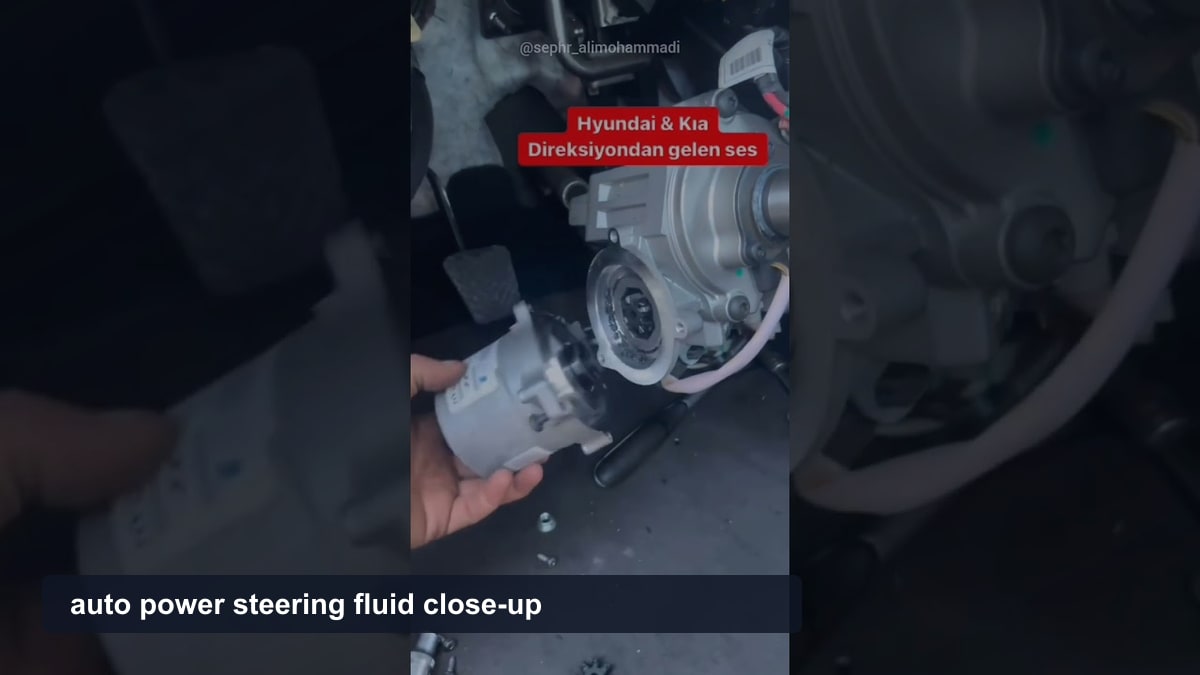
A fuel economy study in the International Journal of Automotive Technology compared the 3 system types. The table below shows each system’s pump drive, fluid use, and fuel economy gain over hydraulic power steering (HPS) in the FTP-75 cycle. FTP-75 is a US federal test cycle that simulates city and highway driving.
| System Type | Pump Drive | Uses Fluid | Fuel Economy Gain vs HPS |
|---|---|---|---|
| Hydraulic power steering (HPS) | Engine belt | Yes | 0% (baseline) |
| Electro-hydraulic power steering (EHPS) | Electric motor | Yes | 1% |
| Electric power steering (EPS) | No pump | No | 1.7% |
The study measured a 1% gain for EHPS and a 1.7% gain for full EPS compared with HPS. Automakers estimate that EPS improves fuel economy by roughly 4% over hydraulic units. A reservoir under the hood indicates a hydraulic system. A vehicle with no reservoir uses EPS.
Which Auto Power Steering Fluid Does a Vehicle Need?
A vehicle needs the fluid specified by its manufacturer. Specifications vary by manufacturer, and incorrect fluid damages seals and degrades performance. Fluids labeled as compatible with a specification differ in formulation, and some exceed the original standard.
Three sources list the correct fluid:
- Owner’s manual
- Reservoir cap label
- Dealer parts catalog
People Also Ask About Auto Power Steering Fluid
Can ATF be used as power steering fluid?
ATF suits vehicles whose manuals specify it, such as models requiring Dexron or Mercon.
What happens if power steering fluid is low?
Low fluid causes noisy, stiff steering and damages the power steering pump.
Is power steering fluid the same as brake fluid?
No, brake fluid (DOT 3, DOT 4) is glycol-based for brake hydraulics, and power steering fluid is a petroleum or synthetic oil for steering hydraulics.
Do all cars use power steering fluid?
No, vehicles with electric power steering use no fluid.
What color is bad power steering fluid?
Bad power steering fluid appears dark brown or black.
1 thought on “Auto Power Steering Fluid: 4 Types, 5 Warning Signs, and Change Intervals”